Books of 2024

Photo by Caroline Bowen

It is January, probably my least favorite month of the year, so I set myself to the task of putting away the old year and making plans for the new. Last year was not what I anticipated. It took all year to recover from ankle surgery instead of the quick healing I anticipated. I didn’t travel as much but I enjoyed the few trips I took and found them joyful and healing. But what I did do last year was read and read and read. I needed a lot of time resting with my feet up and this was the best way to pass the time. I had my personal best year at 77 books.  Some were huge tomes, some short middle grade, some wonderful with a permanent place on my shelf and some went straight to the sell pile. This year I kept a list so I can look back on each month so this year I’m going to organize my favorites by month.  Let’s look back and see what I read.

January: This month was heavy on the classics with Jane Eyre by Charlotte Bronte (love), The Tale of Two Cities by Dickens and East of Eden by Steinbeck.  It was a snowy month and I had lots of time to read Steinbeck and I blew through it in a couple of weeks. My spiritual read for the month was Thomas Merton’s Asian Journals. Insightful and poignant as this journal documented his final trip before his accidental death in Thailand at the end of his journey.  As I read closer to that fateful day I was struck by the fragility of our existence—it was a hard ending to read.

February: This is when I was diagnosed with my pain syndrome (CRPS) so I did a lot of reading on the subject of chronic pain. I read a book by one of my former professors, Keiran Le Grice, The Lion Will Become Man, about his journey through a health crisis as an alchemical process. I also read The Library Book by Susan Orlean about the devastating fire in the main branch of the LA public library. A few weeks later I went and visited this gorgeous Art Deco library. A good read and a pilgrimage.

Los Angeles Public Library, Main Branch

March: Hamilton and I have been reading/listening to classics together so over the winter we read Huckleberry Finn by Mark Twain, Farewell to Arms by Earnest Hemmingway and The Prince by Machiavelli.  Since I didn’t have a good classics education in the religious school I attended, I’m enjoying catching up on so many great works of literature. Which leads me to….

April:  I did it! I read/listened to Don Quixote by Cervantes. For months (992 pages) I wandered Spain with the beloved Don Q. What a charming character, what an amazing book! Wow. Has this stood the test of time for one of the oldest novels—and it is funny too. The big thing I’ve learned from Ben at the Hardcore Literature Book Club is that translation is everything.  All these years Don Quixote has been given a bad rap for being too hard to read and sounding like the King James Bible when all he needed is a good translator.  Enter Edith Grossman whose modern translation published in 2003 has Don Q’s adventures still fun after 400 years.  Do yourself a favor and listen to the first few hours and see if you don’t fall in love with this book.  It is one of the top novels of all time.

May: I left Spain to enter the land of the Unicorn as I read several books about the unicorn tapestries before my pilgrimage see them at The Cloisters in NYC. I read The Oak King, The Holy King and The Unicorn by John Williamson. This scholarly but readable book got me ready to spend a delightful afternoon with the Unicorn. I can never get enough of unicorn tapestries. While in NYC I went to Strand Books and found one of the best books of the year. Theoretically there are 23 miles of books at Strand Books.  Where do I even start. So I just went to one history section and stood there until I found a book that looked interesting and then left as I was still not able to stand for very long.  My treasure—Marcel’s Letters by Carolyn Porter. Carolyn bought some old French letters at an antique store in Minnesota because she liked the penmanship.  Then she had them translated and that started her odyssey to find Marcel and learn his story of the French resistance in WWII. This true story is a must read.

June: I read three great classics I can’t believe were new reads for me. First was Walden by Henry David Thoreau in a beautifully illustrated edition. Then Hamilton and I read Barchester Towers by Anthony Trollope, a very fun story of Victorian manners and power struggles in a small Parish in England. Then I finally read Pride and Prejudice by Jane Austin. Now mind you I knew the story well as I have seen every movie/series adaptation several times. (My favorite is the 1980 version). But the book is much better. What I love about reading the classics rather than just watching the adaptation is I get so much more of the interiority of the characters.  Pride and Prejudice will be on my reread list and Emma is on the TBR for this year.

July: I continued my reading about healing body, mind and spirit.  I read Quantum Mind and Healing by Arnold Mindell and Childhood Disrupted by Donna Nakazwa. Other books I read through the year about healing were The Way Out by Alan Gordon, Unlearn Your Pain by Howard Schubiner, and It Didn’t Start With You by Mark Wolynn.  My personal favorite, The Language of Emotions by Karla McLaren, had been sitting unread on my shelf for over a decade but it was there waiting for me when I was finally ready to take in the information.

August:  Seems I read a lot of modern novels during the summer. I guess I needed some escape reading.  I read Excellent Women by Barbara Pym, delightful and old-fashioned. The Keeper of Lost Things by Ruth Hogan, perfect for a long layover. The Frozen River by Ariel Lawhon, a wonderful historical novel set in colonial America.  A Month in the Country by J. L. Carr, a short but beautiful novel about healing after the trauma of war.  Manboy by Vince Vawter, Vince is a neighbor of mine who’s coming of age novel is set in 1968 Memphis, Tennessee the weekend Martin Luther King, Jr was assassinated.

September: I had several books that didn’t go well or I didn’t finish so I just went for easy and read Courtiers by Valentine Low about life behind the scene in the British royal family.  I also had a lot of housework after a major ceiling repair, so I listened to 84 Charing Cross by Helene Haniff and A Tree Grows in Brooklyn by Betty Smith.  Just the distraction and company I needed while endlessly cleaning, polishing and painting

October, November, December: Ok, I’m starting to wear down from all this reading so let’s speed this up a bit with the best of the best.  Maid, The Hours, The Book of Pearls, The Soul of Money, The Nest, The Picture of Dorian Gray and Before the Coffee Gets Cold—loved them all.  Hamilton and I finished our year of classics with Far from the Madding Crowd by Thomas Hardy—the writing is mesmerizing.

Hopefully there are a few books that caught your interest. I’m continuing to love reading the classics and have a whole agenda for this year through The Hardcore Literature Book Club.  I continue to enjoy my neighborhood book club which brings me into the world of modern fiction, and I will always have a spiritual book to savor first thing in the morning as the light comes up. 

Family trip to our favorite used bookstore. Setting up our TBR for 2025

Books of 2023

Well, I’m snowed in.  Tennessee had an epic snowstorm followed by extremely cold weather. Our 8 inches of snow will linger for a few days so I have nothing better to do than read books, write about books, sort books and dust books. A perfectly delightful way to spend a cold winter day in my opinion.  2023 was a good reading year at over 50 books reading and listening, sometimes both at the same time.  Cold winter days, hot summer days by the pool and long surgery recovery in my recliner days gave me lots of time to read and now I’m happily sorting these wonderful books into categories.

Category One is re-reads.  I’m not normally a re-reader but I did re-enjoy several books this year. I re-read a lot in my childhood and a soothing book is so fun to revisit.  It brings back memories of the first read—the time and space the book enjoyed the first time that allowed it to be re-loved a second time and make a new memory and emotion.   The Mystery of the White Lion by Linda Tucker was now re-read in context in South Africa. What the Psychic Told the Pilgrim by Jane Christmas is a Camino pilgrimage book I re-read with friends who also dream of walking the Camino. A Gift from Brittany by Marjorie Price was a comfort read many years ago and now it was a delight and a reflection on some tough times that have long since passed.  The Shelf: Adventures in Extreme Reading by Phyllis Rose now reflects my own quest for extreme reading experiences.

Speaking of extreme reading, just as I promised myself last January, I read James Joyce’s Ulysses. Yes, I summited my own personal reading Everest. Ulysses is not everyone’s quest, nor should it be, but it was mine, all 933 pages of stream-of-consciousness prose.  Everyday for a couple of months I would listen/read for 30 minutes and that was about all I could take.  I listened to the lectures for some much-needed help and kept going until one fine spring day I finally finished.  I’m glad I made it through, and I see why it is so important in the development of modern literature.  Time will tell if I get called back to James Joyce but, in the meantime, I am savoring my armchair triumph.  I’m keeping my copy as a trophy.

Continuing my literature quest for the year, I read some of the most delightful books of my life.  Don’t be intimidated by these classics–they are famous for a reason.  After Ulysses I read Virginia Woolf: Mrs. Dalloway, Orlando and A Room of One’s Own. I also read some of Virginia’s biography by Hermione Lee.  On our trip to Canada, Hamilton and I listened/read Moby Dick by Herman Melville.  I didn’t really have preconceived ideas but didn’t think a whaling novel would be my thing.  Ohhh was I wrong.  Some of the most beautiful and insightful writing in the English language.  If you want a very rewarding reading challenge read/listen to Moby Dick.  I only had a vague idea of the ending, so I relished the last page of this epic novel.  Middlemarch by George Eliot was what first inspired me to take a deep dive into classic literature and the two months I spent in a recliner gave me the time and space to savor this glorious 688-page/36-hour novel.  My final great book of 2023 was Jane Eyre by Charlotte Bronte. I read it over 30 years ago and loved it and I loved it even more in the re-read and will be on my re-read list for many decades. What a beautiful and very readable book. In 2024 I’m going to keep on my literature quest with Ben at The Hardcore Literature Book Club. I’m very excited about this year’s book schedule.

completed books

In the spiritual category I read about nine books.  My favorites were Advice Not Given by Mark Epstein, The Endless Practice by Mark Nepo and A Year in the Woods by Torbjorn Ekelund —which is more of a nature book but nature and spirituality cannot be separated in my life. I also enjoyed Walking a Literary Labyrinth: A Spirituality of Reading by Nancy Malone.

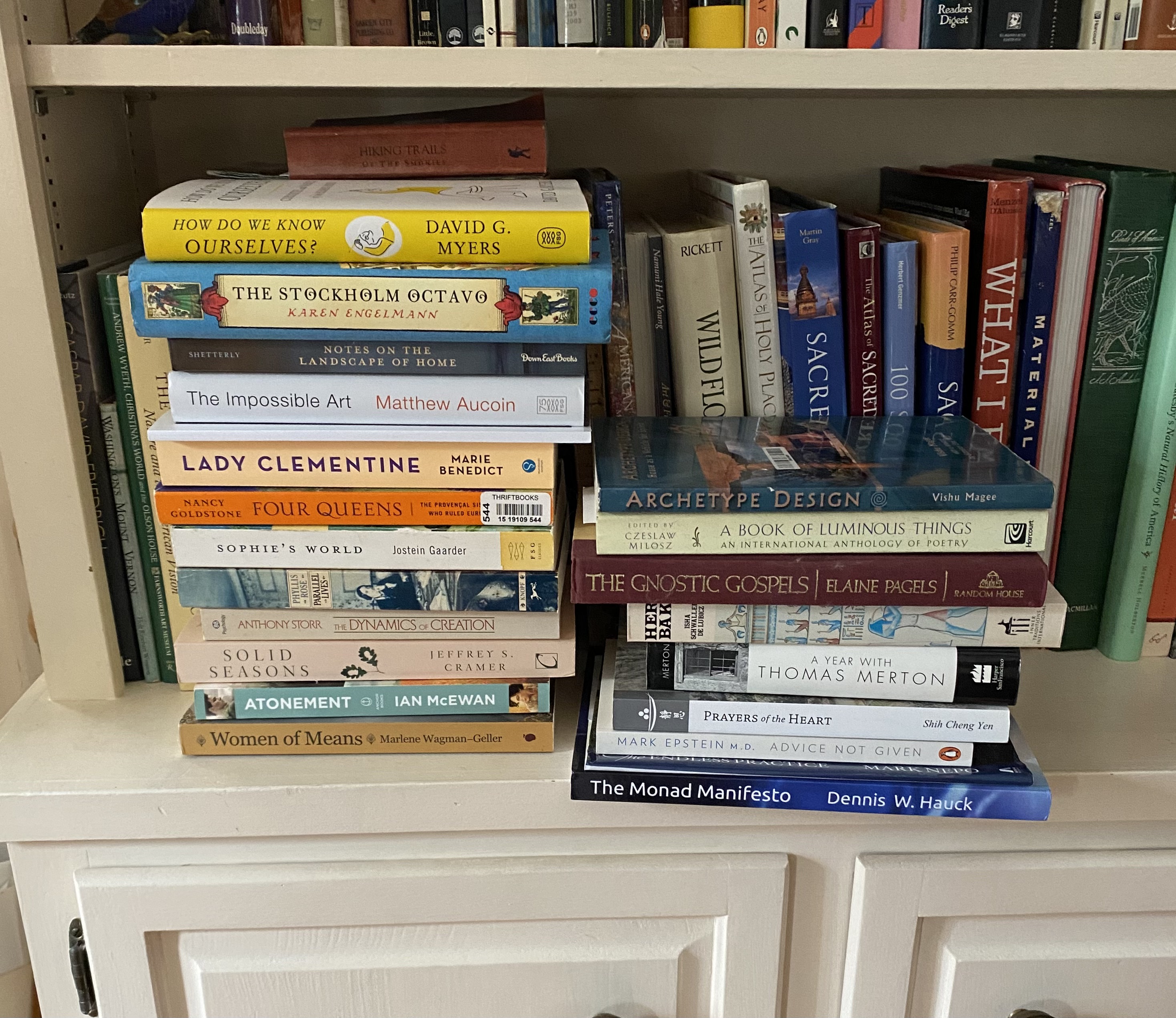
Now, for the final non-fiction category. Mapping the Darkness by Kenneth Miller is about the history of the science of sleep which is a very late development in our medical knowledge.  I was particularly interested in this book because my father took part in these early sleep studies at the University of Chicago in the 1950’s- he would have personally known the researchers in the book.  Reading this book was like a little glimpse into his past and I felt comforted by knowing a bit more about this part of his life.  I did a deep dive into opera and particularly modern opera with The Impossible Art by Matthew Aucoin—remember I had nothing to do for over two months and my mind needed lots of attention.   I also liked Selfie: How the West became Self-obsessed by Will Storr and Strangers in Paradise by James Grubman.

Some of the books of 2023 are going on the library shelves, some are getting sold to pay for new books and a few prized books get their own special place in my heart.  I’ve started my new pile TBR (to be read) for 2024.  I usually keep 3-4 going at all times for any mood or concentration level.  I have a growing pile of literature, spirituality, light novels and non-fiction waiting to take me into new worlds..

2024 TBR pile

Nova Scotia

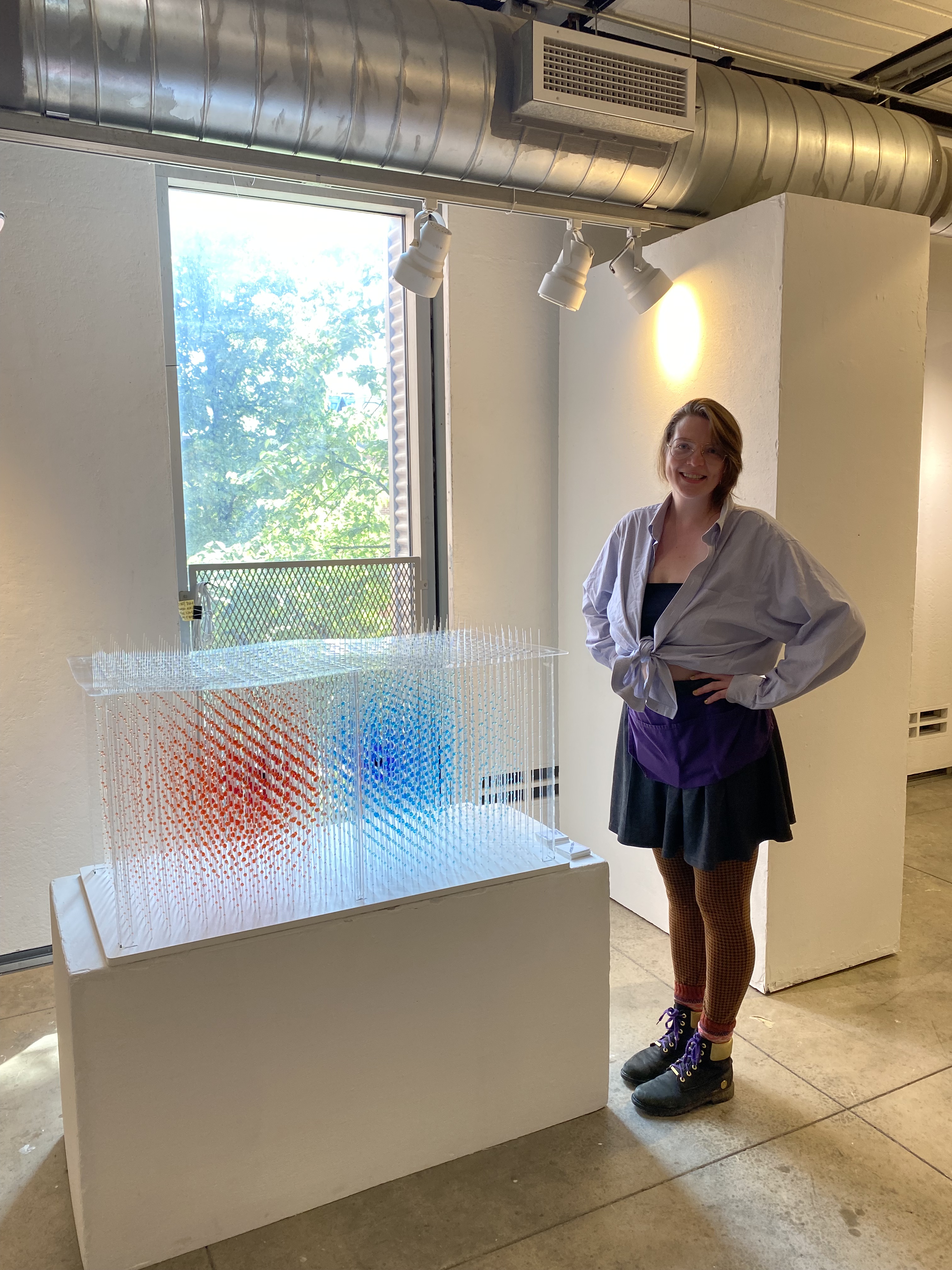
Every year Caroline attends a conference for math and art called Bridges and it is the highlight of her year.  This year Halifax, Nova Scotia hosted the event, a place Hamilton and I had on our travel wish list.  Since she always creates a new sculpture to show in the gallery of the conference, we offered to drive it to Halifax so she could make anything she wanted as long as it fit in the back of the Subaru.  Caroline started creating and I started planning—we were both in our happy places.

It is a very, very long drive to Halifax from Tennessee (1700 miles) so we made plans to enjoy the journey and stop along the way.  As always I enjoy the beautiful scenery up the eastern United States but on this trip, I wanted to make some literary pilgrimages.

My sister lives in western Massachusetts and we stopped by for a few days to enjoy her lake home and culture of the area.  We went to Tanglewood, the Boston Symphony’s famed summer open air venue. The evening was picture perfect as we listened to a Mozart piano concerto in the fading light. After the intermission the stars came out and Mozart’s Jupiter symphony enveloped us in the darkness.    

In near-by Lenox, Massachusetts, is the home of Edith Warton, the first woman to win the Pulitzer-Prize in fiction for The Age of Innocence. Before becoming a world-famous novelist, she wrote books about gardens, architecture and interior design.  Edith had a passion for beautiful homes and built a large summer home in 1903 called The Mount that reflected her love of balance and symmetry in architecture.  Well, you know how I love homes and especially homes that inspire great literature.  Our tour guide, Madison, took us around this remarkable home that became a girl’s school and was abandoned until it was restored around 25 years ago to memorialize Edith’s talent and vision.  Later in life Edith lived in Europe and became a correspondent and humanitarian in the first World War.   It was a magical visit and I came away inspired by Edith’s remarkable and varied life.

A few days later we took the ferry across the Bay of Fundy from New Brunswick to Nova Scotia and visited the historic town of Lunenburg and the picturesque Peggy’s Cove lighthouse then headed to Halifax where we met up with Caroline and friend Maddie who flew up that morning.  Over the next couple of days, we enjoyed the Halifax wharf and maritime museum, ate seafood, set up Caroline’s sculpture in the gallery and relaxed from our long drive.

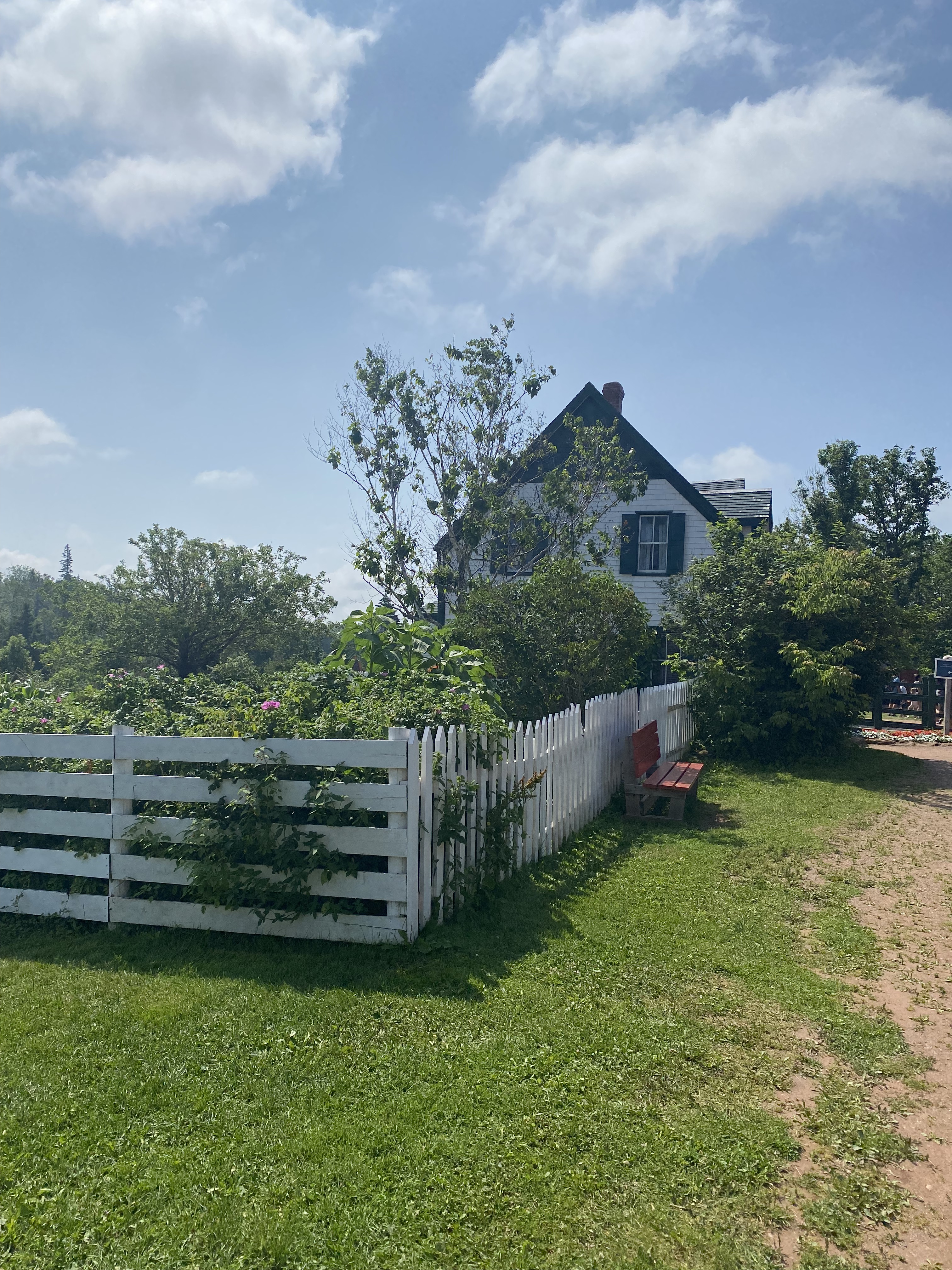
Caroline and Maddie stayed on in Halifax to attend the conference and Hamilton and I set out to explore more of the provinces.  Like many young girls I fell in love with Prince Edward Island as the land of enchantment in the Anne of Green Gables novels by Lucy Montgomery.  So our next literary stop was Cavendish, PEI, and the actual home that inspired Green Gables. The heroine of the books, Anne, was a dreamy, idealistic girl who loved beauty and nature and was grateful to be adopted and finally have a real home, Green Gables.  The home belonged to Lucy’s cousin and is now restored and furnished as it would have been at the turn of the last century.  I could see Anne in every room and the gardens and down Lover’s Lane and by the Lake of Shining Waters. I was a little girl again living my beloved book.

We found the rest of Prince Edward Island equally delightful with pristine farms, potato fields in full bloom and rocky shores.  We spent the night in an old convent that is now a luxury hotel in the capital city of Charlottetown. A seafood diner and ice cream on the wharf at sunset brought this day on the enchanted island to a perfect happy ending. 

The next day we took an early morning ferry across the foggy St. Lawrence Bay back to Nova Scotia. After getting gas and groceries we headed up to the top of Cape Breton Island on the famed Cabot Trail, a beautiful 180 mile drive around the coast line of the island. We took our time and stopped to see the rocky coast at the overlooks and spent two nights at the top of the island just relaxing and enjoy some quiet time where the St Lawrence Bay meets the Atlantic Ocean. We felt like we were at the top of the world and alone with the haunting sounds of the loons on the bay.  On our way back to Halifax we made our next literary stop, Gampo Abbey, the home of the Buddhist nun and author Pema Chodron.  We didn’t have time to go to the abbey but at the first overlook I spent some time looking at the isolated land and shore of the abbey grounds.  This rugged coast is Pema’s refuge from the world that allows her work to blossom and feed the souls of those of us who read her wise words. Some of her best-known works are When Things Fall Apart and The Wisdom of No Escape

We arrived in Halifax long enough to pack up the sculpture and then headed down the long road back to Tennessee. We broke up the trip coming home with stops in Maine and New Hampshire to see friends and then the final long drive home. But on those long driving days we had company: great literary company, for the entire drive Hamilton and I listened to one of the great books of American literature, Moby Dick by Herman Melville. I’ve been on a literary quest this last year and Moby Dick was the perfect shared literary experience for the two of us.  We chose a wonderful narrator on Audible, William Hootkins, and I read along in the book when I wasn’t driving.  We were so close to finishing this 26-hour epic by the time we got home and have finished bit by bit in the evenings.  The writing is spectacular and the insight into sea-faring life in the 1800’s are very compelling and helped the long road go by as we were busy living life on the open ocean with Captain Ahab and his crew.

It was an epic two-week trip of 4400 miles, 10 states, 3 provinces and 345 pages of Moby Dick, and we loved it all.  But I think about the literary stops, the beautiful writing, the insights into the human heart and soul from Edith and Lucy, Pema and Herman. Such a diverse group of writers, but writers that each had a unique voice and perspective that expands my inner worlds as I explore the outer worlds. For me that is exactly the companions I want on my pilgrim’s journey.

Books 2022

Library in Winter

The cold rainy days of January have settled in. Christmas is packed away for another 11 months and the glitter and tree needles are vacuumed and dusted from the parlor. The happy memories linger and I now indulge in a new delight—reviewing the books I read last year. My 2022 reading goal was 4 books a month, either listening or reading. In order to keep track of this goal I decided to have a basket in the corner of the library to hold my finished books and I could always go back to my Kindle and Audible to tally up the year’s treasures. As the year progressed my stack passed the top of the basket and spilled onto the floor in a precarious pile. I’m happy to say that I surpassed my goal and read/listened to over 50 books. I like to read around 50 pages a day usually in several different books. Sometimes I read nothing, sometimes I read over 100; it just depends.

This last week I sorted the books out and put them in three piles: to share, to sell and to keep. Some of the books at the bottom of the pile I had completely forgotten about but I was glad to see some old friends. There were books I was happy to part with, some I was on the fence about and a few that will never leave my library and have become treasured companions.  So here are my favorites across several different categories.

First thing in the morning I like to read something spiritual. Those early hours when the house is dark and I’m warmed by my first cup of coffee is the time that I like to read something to warm my soul. My favorite was A Journey of Sea and Stone: How Holy Places Guide and Renew Us by Tracy Balzer.  This beautifully written book took me back to my perfect day on earth on the holy isle of Iona.  I want to read it again already. I also love, Thrive: Living a Self-Healing Life by Valarie Budayr, my dear friend and fellow pilgrim. A guide to healing trauma, Valarie sets out loving and actionable steps to help anyone find a more vibrant life.

This year Egypt was once again on the reading list. After a trip to see NYC to see the Egyptian opera Akhnaten not just once but twice in the same week, I wanted to continue reading more about that magical land. Hieroglyphic Words of Power: Symbols for Magic, Divination and Dreamwork by Normandi Ellis, is a full immersion into an ancient language that still hold important wisdom. I read about one hieroglyph a day for several weeks as a daily meditation.  I also recommend Embodying Osiris: The Secrets of Alchemical Transformation by Thom Cavalli. This book combines the ancient wisdom of the Egyptian gods and alchemy with the modern work of Jung—not easy to do but Thom does it masterfully.  I also liked Songlines of the Soul by Veronica Goodchild and The Living Labyrinth by Jeremy Taylor.

In the non-fiction category I loved The Big House: A Century in the Life of an American Summer Home by George Howe Colt. For those of us who have loved and lost homes, this beautifully written book helps bring words to the memory and loss of a beloved place.  Amanda Montell’s book Cultish, was an enlightening read about how deeply influenced we are by the language of persuasion. I also liked Uprooted by Page Dicky and A Pilgrimage to Eternity by Timothy Egan.

I love to read about writing, secretly hoping to find the key to making writing easy, no luck yet. But I did find Pat Schneider’s gorgeous books, How the Light Gets In and Writing Alone and With Others.  Writing hasn’t become blissful for me quite yet, but Pat has definitely helped me let go of some of the pain and reluctance. She is a remarkable writer worth reading even if you aren’t interested in writing. She left a writing education legacy that is being carried on by the Amherst Writers and Artists.

For my neighborhood book club we usually read fiction—well, I usually listen to the fiction. So, this year I enjoyed The Weight of Ink by Rachel Kadish. Wonderful writing and a compelling story kept me going through this 23-hour audio book—it was that good.  In October I had a lot of wood siding to paint so I kept entertained by The Midnight Library by Matt Haig—it made me want to go paint so I could continue the story.  I also put up my Christmas trees to The Night Circus by Erin Morgenstern.  Yes, it takes an entire audio book to put up my Christmas and take it down and that is how much I love Christmas.

I love the arts and have spent a lot of my life learning about great music, dance, and fine art but I have almost no experience with great literature outside of one good year of English in high school.  I’ve wanted to read more classic literature but in January my attempt at George Elliot’s Middlemarch came to a rather quick end on page 29.  But luckily my YouTube addiction came to the rescue and I came across Ben McEvoy’s Hard Core Literature Book Club—thank you book lovers algorithms. I signed up for his Patreon book club for the lecture series and like magic I have read four great books in just three months. I have cracked the code: good lectures, a reasonable pace, the combination of reading a physical book and listening to the audio at the same time, and an on-line community of other people who also read multiple books at once. I read Wuthering Heights by Emily Bronte, Siddhartha by Hermann Hesse, The Mystery of Edwin Drood by Charles Dickens and my absolute favorite Persuasion by Jane Austin.  I proudly have my new reading accomplishments lined up on their own shelf awaiting many more to come.  January/Feburary’s ambition– Ulysses by James Joyce—wish me luck.  

How was your reading/listening year?  What books are awaiting you in 2023? I came across this great quote on Facebook “Think not of the books you’ve bought as a “to be read” pile. Instead, think of your bookcase as a wine cellar. You collect books to be read at the right time, the right place, and the right mood.” Luc Van Donkergoed. 

Books for 2023

Please visit my other blog www.thetimelesstarot.com

Sedona

Even though I had not consciously planned my trip to Arizona to be about my dear mentors and teachers, it quickly became clear that my time in Arizona was a pilgrimage not only to beautiful sacred places but to the memories of my dear friends. The day we were traveling from Canyon de Chelly to Sedona, October 4, was my dear spiritual mother Rachael Salley’s 80th birthday. Rachael loved her birthday. Rachael has been gone over two years now and I miss her every day. I was so glad Val and I were together to celebrate. Rachael always said we were her cosmic daughters and spiritual sisters. That night, we had supper on the restaurant patio, in beautiful Sedona, under the crescent moon shining just over the red rocks as we celebrated Racheal’s memory and legacy. We had a special dessert as Rachael had a real sweet-tooth and never missed a good dessert.

I’ve been to Sedona, Arizona, twice before but it had been over ten years and I felt really called to visit again.  I also wanted to visit Sedona again in the memory of my dear friend Page Bryant. I knew Page over 20 years and spent many happy hours in her home. Page was a very wise woman and fortunately left that wisdom for all of us in 14 books. She was very connected to land and sacred sites and the powerful earth energy at those sites. In the early 1980’s Page was the first to identify the energy spots in Sedona that are now the famed energy vortexes that draw so many people to that land. (Starquest Sedona, by Page Bryant) When she moved to North Carolina in the 1990’s, she connected to the same earth energy and wrote her most popular book, The Spiritual Reawakening of the Smoky Mountains.  Page taught me about sacred land and the honoring of holy places; her work weaves through all my writing.

So, with great devotion to Page, Rachael and Peter Calhoun, I was grateful to be back on that holy ground again. It really didn’t matter what I did in Sedona, just being surrounded by the beautiful red rocks and deep green forest was why I came back to visit. But you know me, I have to get out and be a part of the that places as much as I could  We started our visit at the Chapel of the Holy Cross, a beautiful chapel jutting out of the rock with uninterrupted views of the dramatic landscape. It was a perfect place to meditate and remember Rachael on her birthday. I lit a candle for her, Page and Peter.   

The first full day, we hired a wonderful young guide to take us to some lesser-known places. Fortunately it was not a jeep tour as we had enough of four-wheeling in the Canyon de Chelly.  Instead, we stopped by Airport Mesa to look at the beautiful view. Conner, our guide, talked about the geological and spiritual history of Sedona. Then we went to the Peace Park where two Buddhist Stupas were nestled close to the forest and towering red rocks. It is a place for meditation and prayer and I felt the great peace of those millions of prayers flowing from the prayer wheels.  The third spot was Rachel’s Knoll, named for the woman who had preserved the view for visitors far into the future. I just sat on a rock and breathed the warm western air, so content to take in all of the energy of the land.  After a pizza lunch, Val and I visited some crystal shops and bought some rocks and some incense.

Val and I were staying in the Amara hotel which happened to have a great pool with an even greater view. Since I am a pool person, I spent the afternoons soaking up the October sunshine, reading and swimming—my favorite things. Every evening, Val had made dinner reservations at some nice restaurants and we enjoyed eating and drinking, talking and remembering all of our wonderful trips we’ve taken together. 

Our last day in Sedona, we were invited to visit an internet acquaintance of Val’s, Rhianne (www.rhiannenewahnd.com) a long-time resident of Sedona.  Although we had never met before, it was like we were long lost friends. First, we had a tour of her beautiful garden and then settled in for a long chat. Rhianne has hosted women’s groups for many years and I was very interested in how she formed and ran the groups.  She also has developed a wonderful system for spiritual guidance by tapping into the different feminine archetypes that we all hold in our hearts and minds and was kind enough to allow Val and I a chance to experience one of our own archetypes.  Three hours past as if there was no time.  It was hard to leave our new friend but it was getting late and we were very hungry.  That afternoon I spent down by the river, relaxing and reading and enjoying some quiet reflection until the bugs started after my ankles.  Another beautiful dinner and a visit to some art galleries made for a perfect last evening.

It was time to head back to Val’s home in Santa Fe and we felt we did what we needed and wanted to do in Sedona. I enjoyed the people we met, the beautiful scenery, delicious food, and sacred land.  I felt Page, Rachael and Peter’s kindness and wisdom with me. I loved honoring the land and the dear souls who influenced my life. I couldn’t be more grateful.

Canyon de Chelly

Many years ago, I was fortunate to study with a former Episcopal priest come shaman, Peter Calhoun, author of Soul on Fire. He and his wife Astrid took people on vision quests in the Southwest, especially Utah and Arizona.  Although I never did a vision quest, Peter talked about Canyon de Chelly on Navajo land in northeast Arizona.  Peter found the canyon to be sacred and his comment has been in my memory for almost two decades waiting for the right time for me to visit this sacred site.

Last year, my dear friend Val and I started planning another girls’ trip in the southwest where she now lives. I mentioned I really wanted to see Canyon de Chelly (pronounced deshay). Since we have visited Chaco Canyon twice and loved the experience, I knew that Canyon de Chelly would be the perfect place to explore next. On the land of the Navajo nation, the canyon is sacred to the native people who live there. We started planning our trip which was not as straight-forward as visiting most national monuments.  Covid has hit the Navajo hard and the canyon was closed for 2 ½ years. They also protect access to the canyon as their spiritual land.  There are roads to look down into the canyon that anyone can drive but to get down into the canyon proper requires a Navajo guide and a four-wheel drive vehicle. 

Val picked me up at the Albuquerque airport, and after a quick lunch we headed northwest to the far corner of Arizona, not far from the famed Four Corners region. I always enjoy seeing the big sky, barren land and deep colors of New Mexico and Arizona. It is so foreign, beautifully desolate and grand compared to my lush, green Tennessee.  I find the change refreshing as we watched the storms in the distance—you can actually see the rain falling from the clouds in the distance while still remaining in the sunshine. Just under four hours later, we arrived at the little town of Chinle, Arizona, checked into the Holiday Inn and had Navajo tacos in the adjacent restaurant.  I love fry bread and it was the perfect start for our adventure. 

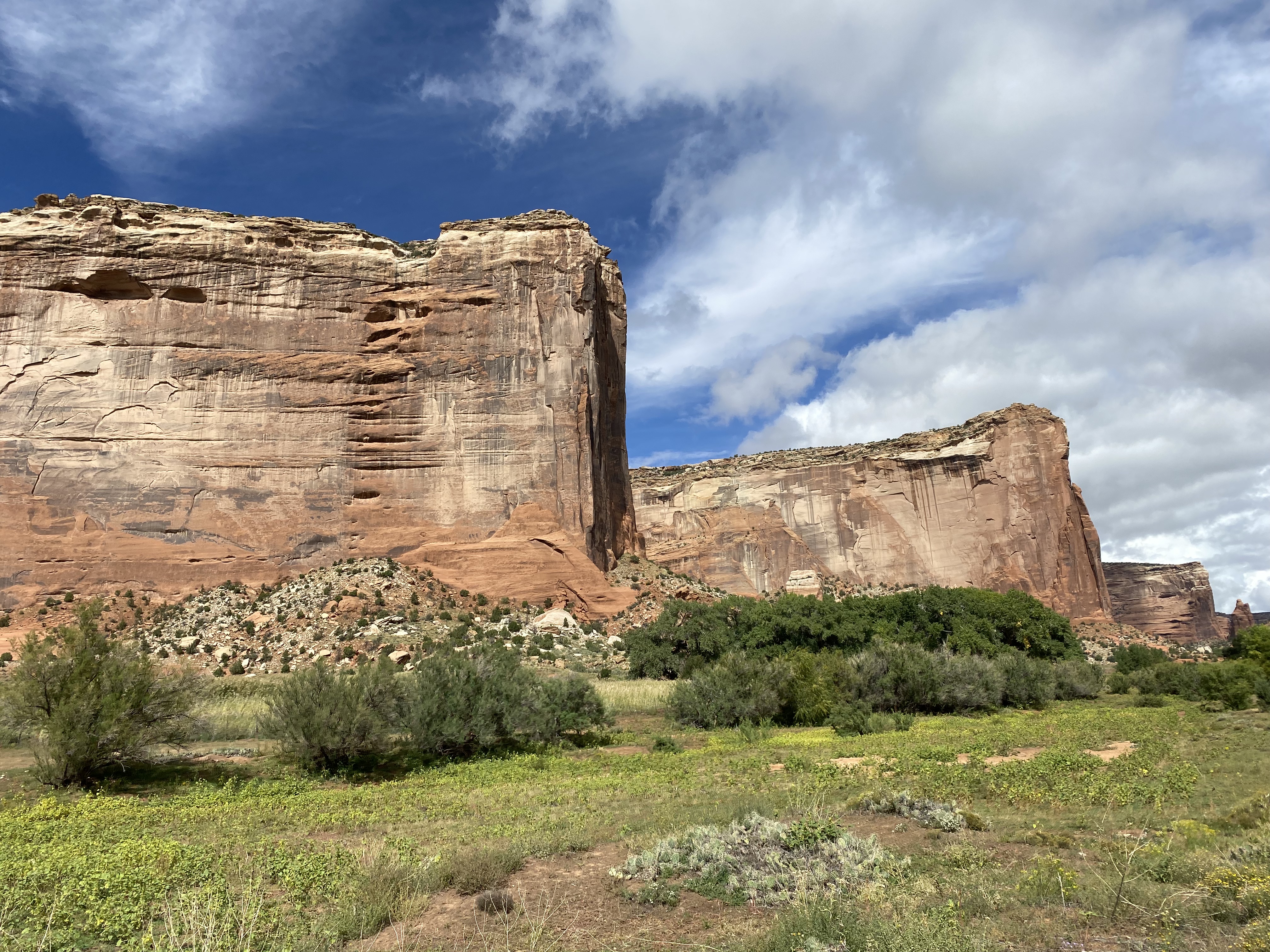
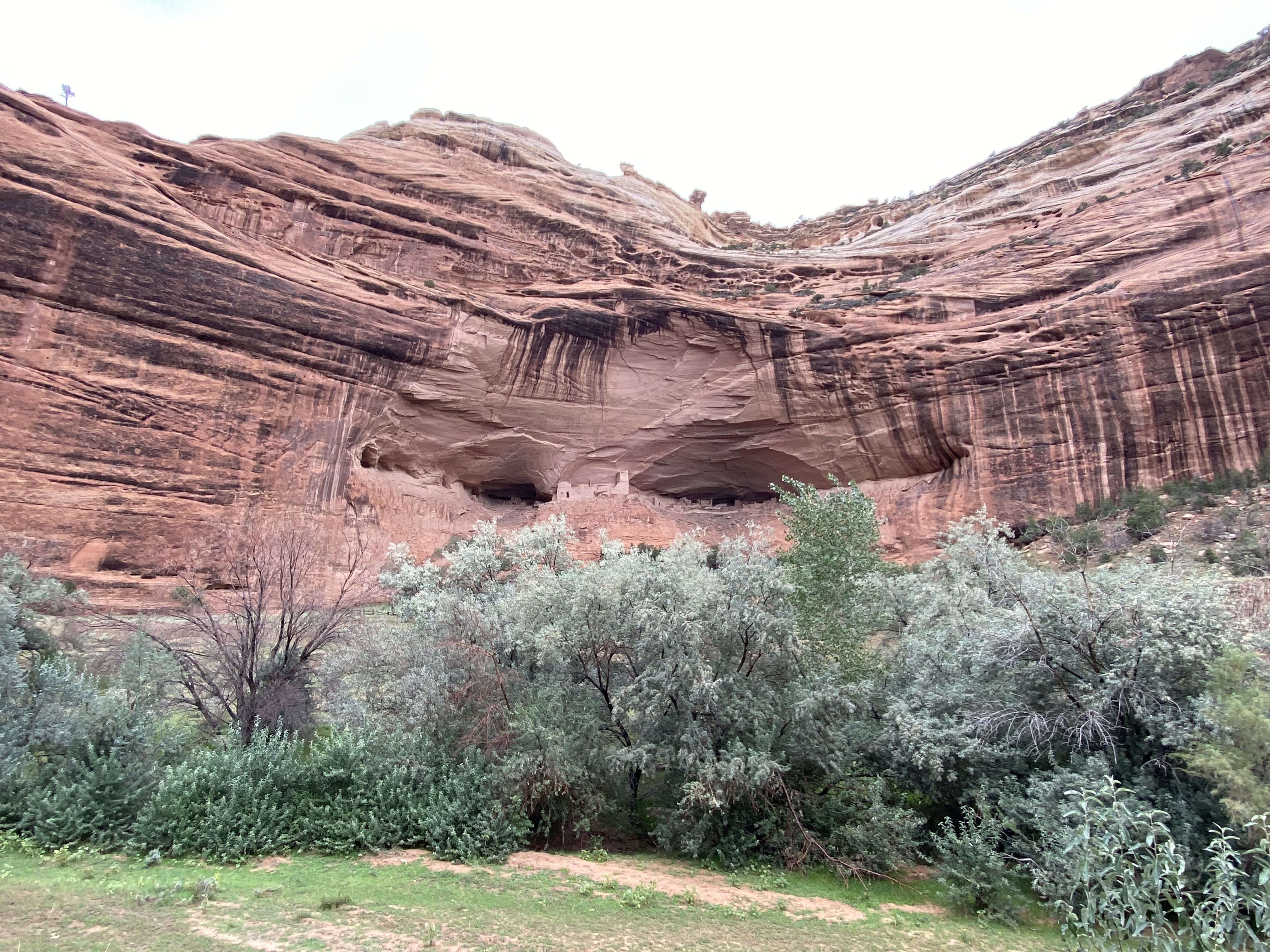
The next morning, we were met with an unusually rainy and chilly day for our tour. But the rain didn’t last long and we were able to take off layers of clothes as the day went on.  There are half day and whole day tours of the canyon and of course I wanted as much time as possible. We were the only two people taking the all day (6 hr) tour and our driver David quickly got us on the road. Now in the canyon, ‘road’ is a relative word, and because of the recent rains, the first part of the road was actually a river that we forded back and forth several times.  But soon we were at the first pictographs in the canyon: horses, hands, Kokopelli (the flute-playing trickster god), lines representing water and other figures covered the sandstone walls. We also stopped by ancient Anasazi ruins tucked into the cliffs. When they were occupied a thousand years ago, the bottom of the canyon was 30 or more feet higher. But it is a testament to the builders that the mud bricks still remain and we can still wonder at their ancient civilization. Today, there are a few older Navajo that still live in the canyon during the summer.

Every thirty minutes or so David would stop our vehicle and come alongside the back and tell us more stories and point out more wonderful things in his Navajo-accented English. David has taken visitors into the canyon for over twenty years, and on that day, I was very grateful for his detailed knowledge but, more importantly, his expert driving.  The tours out of Thunderbird Lodge are in open Swiss Army vehicles that seat around ten on two bench seats. These heavy-duty six-wheel drive trucks were essential for the deeper parts of the canyon. Every once in awhile, David would get stuck, have to back up and engage more wheel power. Several times, Val and I just closed our eyes and counted on David’s expertise to get us over a very rough patch without rolling down the gully. We would later refer to the day as the “Raiders of the Lost Ark” tour. It was all an adventure and I love a good adventure. Our final destination was worth all the jostling and white-knuckle gripping, for the Cave of the Mummies is otherworldly and like walking in a dream. High in the cliffs were large Anasazi ruins, extensive and well preserved. We ate our lunch on a picnic table and reveled in the quiet wildness deep in that long canyon. David would give a shout and the echo would extend deep into the cliffs. We headed back to the canyon entrance and I enjoyed each new view of the 1000 foot rock walls in the changing light.  Every moment was beautiful, new and ancient at the same time.  

Cave of the Mummies

By the time we got back to the entrance we were both pretty tired from the long day of four-wheeling—make that six-wheeling. After quick supper of another delicious Navajo taco and a nice hot bath we were ready to lay down and just be still. But the memory of that beautiful land will linger and remain a highlight of my year. Peter Calhoun was so right, Canyon de Chelly is a very sacred place.

Joseph Campbell

Pacifica

Joseph Campbell Library, Pacifica

Just a short pilgrimage to a neighboring state changed the course of my life. After I wrote this post three years ago, I decided to get a masters at Pacifica Graduate Institute. I really didn’t want to go back to school but the call to new adventure was too powerful to resist. Now I just have two weeks of school until I’m finished. I had no idea that day in Alabama how my life would change. I’m so glad I heard the call.


I was 26 and a new mother when I decided I wanted to be an Episcopalian. I liked the local parish so I had a meeting with the priest to talk about joining the church. We talked about my childhood church and it’s very literal interpretation of the Bible. The priest then said something I will never forget that rocked my world. “You know the Bible is a myth.” Holy Cow! What? Everything stopped in that instant as the foundation of my world view cracked wide open. I barely knew what a myth was, in my narrow world novels, fairy tales, myths and Santa were lies and not allowed. The priest told me to read Joseph Campbell’s The Power of Myth. I read the book but didn’t understand it much, I had no context for the stories or concepts but I knew it was important. It took me an entire year to just wrap my mind around the idea that the Bible was not literal. The stories began touching my heart instead of baffling my brain.

I kept going to church and joined a book club and slowly, stone by stone, dismantled the cosmology of my childhood. When my world view lay in pieces all around me I started to rebuild with the good from my old life but now with the new materials. I read more mythology, Jung and archetypes, and novels. Each new book lead to the next and I spent all my spare time building a new and expanded paradigm that was much more open with plenty of room to grow.

I kept reading Joseph Campbell and watched The Power of Myth. I listen to interviews and kept a copy of Reflections on the Art of Living: A Joseph Campbell Companion in the side pocket of my car. When I had a few minutes waiting in the school pick-up line or for ballet to finish, I would read the wise words. The book was tattered and coffee stained, underlined and loved. The myths, gods and goddesses became an important part of my life. When I went to Egypt for the first time, I knew little of the history but a great deal of the cosmology, I went to live the myths and stand before the gods. I was on the heroine’s journey.

Joseph Campbell was a professor at Sarah Lawrence College and wrote about universal themes of mythologies in all cultures. His book The Hero with a Thousand Faces has been very influential in our modern culture and the ideas helped create new myths for our time. Luke Skywalker is a classic mythological hero that bravely journeyed to the unknown to recover his lost self and bring back the wisdom for his society.

In mid-March I was traveling home from Alabama listening to some tapes of Michael Toms’ 1979 interview of Joseph Campbell. I had those tapes for many years and was going to listen to them one more time. I nearly had to pull over, on those tapes where exactly the validation I was needing about some materials I was working on about alchemy. Alchemy is not a subject usually associated with Joseph Campbell but there it was, an interview from nearly 40 years ago, perfect in that moment. The timeless quality of Joseph Campbell’s work is an indication of the deep universal Truths he was able to convey to the world. His work become new again as I grew and could hear it on a new level.

Two weeks later I was in southern California and had a day free to “follow my bliss” as Joseph Campbell so famously taught. I headed up the coast to just below Santa Barbara to Pacifica Graduate Institute and the Joseph Campbell Library. Nestled in a beautiful garden of a campus was a small library that holds all of Joseph Campbell’s personal books. Usually only accessible a few hours a week, the archivist happened to be free so he ushered me into a small dark room with bookshelves from floor to ceiling and a few display cases in the middle. I started to ask questions about alchemy and the librarian got on an old wooden ladder and pulled down a book. It was Carl Jung’s book on alchemy, Mysterium Conjunctionis. In it was Joseph Campbell’s prolific and very tidy underlining and notes. In front of me, under my fingertips was the meeting of two great minds. I turned the pages and read passages and notes and breathed in the magic of those two men who together restored the mythical journey to our modern world. Their work has restored the magic and mystery to my barren, literal life.

I spent a blissful hour and a half in that library, looking at the books that influenced such a great mind. There was an entire shelf of books on the Grail legend, some of them hundreds of years old. I saw his personal copy of his first book and a copy of The Joseph Campbell Companion with its familiar cover. In the display case were some of his favorite artifacts of ancient deity and a small metal ruler he used for underlining. Joseph was once asked if he meditated, he replied “no I underline.”

The Joseph Campbell Foundation   http://www.jcf.org

Pacifica Graduate Institute  www.pacifica.edu

PacificaIMG_3167

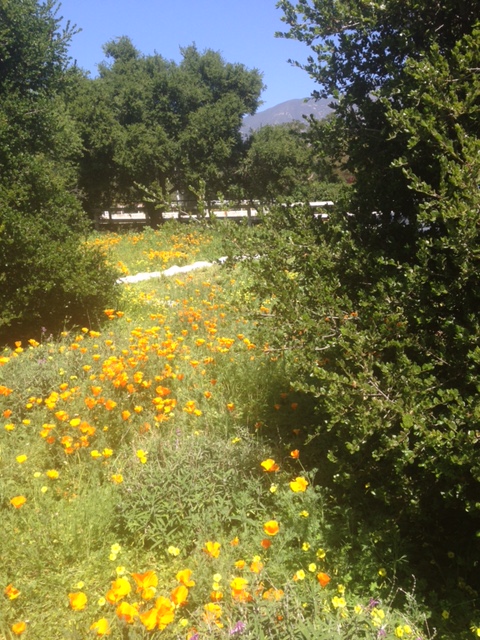
California Poppys,  Pacifica

Basho

Breaking the silence

of an ancient pond,

A frog jumped in to water —

A deep resonance.

This haiku by the poet Matsuo Basho (1644-1694) is one of the most recognizable poems in Japan. Haiku is a short traditional form of Japanese poetry consisting of seventeen syllables divided into three sections of five-seven-five. It was Basho who perfected the haiku form, but he also wrote beautiful prose in the form of a travel log with the haiku inspired by his experiences. The Narrow Road to the Deep North is his best-known work and read by almost every Japanese high school student and translated more than any other work of Japanese literature.

I first learned of Basho while researching pilgrimage. I was already familiar with the haiku form and its popularity in both Japan and the West but going deeper into Basho’s life and work expands my understanding of the form, but more importantly informs my own pilgrimages and soul journey. Although Basho spent a great deal of time traveling, it is this pilgrimage to the Deep North that called his soul. To wander in nature and discover the world was not a luxury for Basho but a necessity for his poetry and the calling of his soul.  On this journey, Basho developed a new form a writing called haibun, which alternates prose and haiku to describe his journey. The prose, equally as beautiful as the poems, explains the physical aspects of the journey where the haiku illuminates the internal images and experiences. He walked 1200 miles over five months with his disciple Sora and planned part of the route to include places described by other writers. Basho’s call to a pilgrimage was not a specific place but to experience whatever unfolded before him. “I myself have been tempted for a long time by the cloud-moving wind–filled with a strong desire to wander”.

Basho’s words are beautiful in their simplicity and grace. He uses a lightness and gentleness to describe nature and life itself. Beauty becomes an essential element in the soul’s journey. Basho found beauty on his journey: in the change of seasons, fleeting moments of sun on dew, a hazy moon, the arch of the Milky Way. He found beauty in the smallest details of cherry blossoms, pine trees, wind and water. Life is fleeting and these details captured the ephemeral moment when life is perfect beauty. Basho took great delight and wonder in these moments that fed his soul’s path. It is in these brief moments that Basho experienced eternity and left a trace in his haiku.

Walking pilgrimages are inherently simple. Life is reduced to what you can carry on your back. Basho’s haiku perfectly alludes to the essentialness of his journey. Pleasure is found in the simple moment of a flower, the soft breeze, or sound of a cricket. Basho left behind the comforts of home and community to see the world in the simplest moments where the sacred is found. Basho doesn’t analyze or offer opinion on what he sees, rather he relates pure experiences as they happen in the moment and in his heart. Haiku becomes the way he expresses his journey. Although haiku is simple in form it is not simplistic for the subtly expressed by the image associations and verbal play enter in the depths of the human heart.

In the essence of his work, Basho is above all a nature poet. All his senses were tuned to the natural world and Basho misses none of the subtleties of the wind, seasons, smell and sound, often bringing him to tears in the moments of pure wonder and grace. His poetry and prose are words of praise and thanksgiving for life in all of its forms. The sea, rocks, stars, mountain, trees, flowers, all participated in Basho’s poems to the ineffable mystery of our world.

Although written almost 400 years ago, Basho’s story and poetry are timeless. His experiences and observations reflect his deep understanding of nature and his own interior life. Pilgrimage, as a time of solitude in nature, becomes a catalyst that opens an important soul space.  Basho heard the call of this soul space and left a beautiful account of what that interior pilgrimage looks like. His words are those of the mystic that sees the sacred in all things and in all places.

The title of Basho’s story, The Narrow Road to the Deep North, reflects the physical road and is a metaphor for the quality of the interior journey for the sacred does not come with broad highways and neon signs. The sacred is found with effort on a narrow path that takes time and sacrifice, suffering and joy. There is no easy and quick way to a lasting relationship with nature and the soul. Hard work and dedication are needed to find these numinous moments when the world becomes alive with wonder as we step out of time into the timeless.

Later this year I am going to Japan to see for myself what inspired Basho. I will be walking part of the 88 Temple trail on Shikoku island, a 1000-year-old spiritual pilgrimage and a sister pilgrimage to the Camino. Basho did not walk this particular trail, he walked north of what is today Tokyo, but the landscape and culture as well as the search for the heart and soul of nature aligns me with the spirit of Basho.  Basho wrote on many subjects that moved him to live in relationship with his soul and thus offers me language to seek the same beauty.


Amid mountains of high summer,

I bowed respectfully before

The tall clogs of a statue

Asking a blessing on my journey


To talk casually

About an iris flower

Is one of the pleasures

Of the wandering journey.


In the utter silence

Of a temple,

A cicada’s voice alone

Penetrates the rocks.


.


Take Joy!

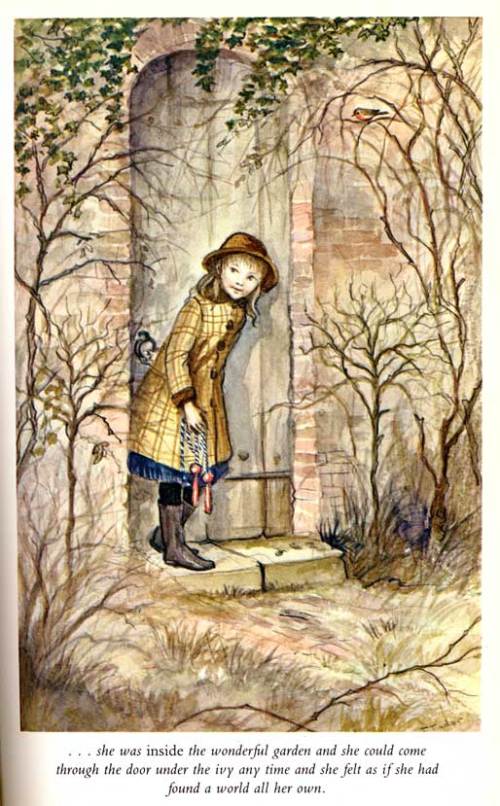
When I was a little girl, I spent many a happy hour reading The Little Princess and The Secret Garden, books illustrated by the artist Tasha Tudor.  The delicately drawn pictures and watercolors add to the enchanting story.  I particularly remember the illustration of the robin showing Mary Lennox the key to the hidden garden.   Tasha (1915-2008) illustrated and wrote dozens of children’s books during her prolific career.

A few years ago, I became fascinated with Tasha again, not just for her art but because of the unique life she crafted for herself.  She was fascinated with the 1830’s and moved to a farm in rural Vermont to recreate a life from that time.   She lived without electricity and wore clothes of the period.   She had a prolific garden and a barn full of animals which she tended with her beloved Corgis.   As an artist, she created the life she imagined and lived it to the fullest.   She used the words “take joy” to express the way she experienced life.   Her darling Christmas book and a documentary about her are also named Take Joy!

So in these last cold days of winter, before the spring comes, I want to encourage you to also Take Joy by finding beauty in the everyday and crafting your life to reflect your joy.   I find that we are so bombarded with everyone else’s ideas and desires, or just what the culture tells us to think and do, that we don’t take the time to really create our unique world.   This week I have been reading Cal Newport’s book Digital Minimalism.  This is a new manifesto on how to loosen the control of media in your life so that you make more conscious choices about how you spend your time and what influences your thinking.  Take steps to mindfully use media so that life isn’t spent in front of a screen but out in the beauty of the world.   The constant bad news causes such anxiety and stress that the beauty all around is missed and then lost.  Choose media that brings happiness to your life, not that glorify the worst of human behavior.

Enter Tasha’s enchanted world for a bit and find that Joy and Take it into your life and then consciously look at your world to find the beauty.   In my world it is the chickadees having their breakfast, the wind ruffling the lake, the early spring frogs croaking in the shallow pond, the lichen on the fallen tree, the smell of the daffodils from the flower market…

I ❤ Books

Blood Wolf Supermoon rising

January has gotten away from me all too quickly.  Christmas delightfully lingered until Epiphany and I barely got the Christmas trees snuggled into the basement when I got a cold that then became bronchitis.  School started up, our water main broke and Caroline needed some surgery (fully mended now).  Whheeww! And I didn’t feel like I was ready to leave 2018 yet.  I want to reminisce a bit about some lovely moments from last year.  There were trips to Taiwan, New Mexico, New York and of course Los Angeles. But what I want to remember and hold on to are some of the lovely things I read and watched so let me share some of my favorite literary moments of 2018.  Hopefully I will inspire something for you to enjoy and I would love for you to leave a comment on what was your favorite book or movie/series of 2018 for me to enjoy in 2019.

Last winter, one of my classes was on dreams.  I have taken classes in Jungian dream work before but there are new and interesting ways of processing dreams.  Dream Tending: Awakening to the Healing Power of Dreams by Stephen Aizenstat takes dreams from strict interpretation to learning how to have a relationship with your dreams and let them enter your waking world.  I spent a morning in a class with Dr. Aizenstat working on dreams and it was a magical experience to see this master dream tender at work.  If you are interested in knowing more about dreams, this is the book to get.

Although I didn’t read this next book for class, it combines work I did in two class on vocation and archetypes.  The Great Work of Your Life: A Guide for the Journey to Your True Calling by Stephen Cope, is a beautifully written book that uses the story of the Bhagavad Gita and weaves it with stories of people (famous and not famous) finding the vocation that comes from the heart.

In November, Alexandra and I went to the LA Opera to see Philip Glass’ opera Satyagraha.  This is the story of Gandhi during his time in South Africa as he developed his ideals of non-violent resistance.  Once again, the opera uses the ancient Indian story of the Bhagavad Gita, to underscore Gandhi’s struggle to find the courage to fulfill his destiny in India.  A unique and powerful work sung in Sanskrit, it is Philip Glass’ masterpiece of opera and social change.   If you love music, I recommend Words Without Music, a memoir by Philip Glass about this remarkable composer’s life and work.  I have several of his albums on my iTunes and I wrote a paper on this amazing opera.

During a week off of school, I read Feet of Clay: Saints, Sinners, and Madmen: A Study of Gurus by Anthony Storr.  A well written scholarly look at the phenomena of gurus, good and bad, this book helped me understand the psychology around gurus and the people that follow them.   Coincidently the Netflix show Wild Wild Country about Bahgwan Rajneesh came the same week I was reading about him in this book.  You know I had to watch it.

A few other books I enjoyed:

Sacred Space, Sacred Sound: The Acoustic Mysteries of Holy Places by Elizabeth Hale

Deep Work by Cal Newport

Process: The Writing Lives of Great Authors by Sarah Stodola

A Life Less Throwaway: The Lost Art of Buying for Life by Tara Button

Some TV series/Movies I enjoyed: 

Howards End (2018 and 1992), The Miniaturist, Durrells of Corfu, Leave No Trace, Jane, Loving Vincent, Darkest Hour, This Beautiful Fantastic